
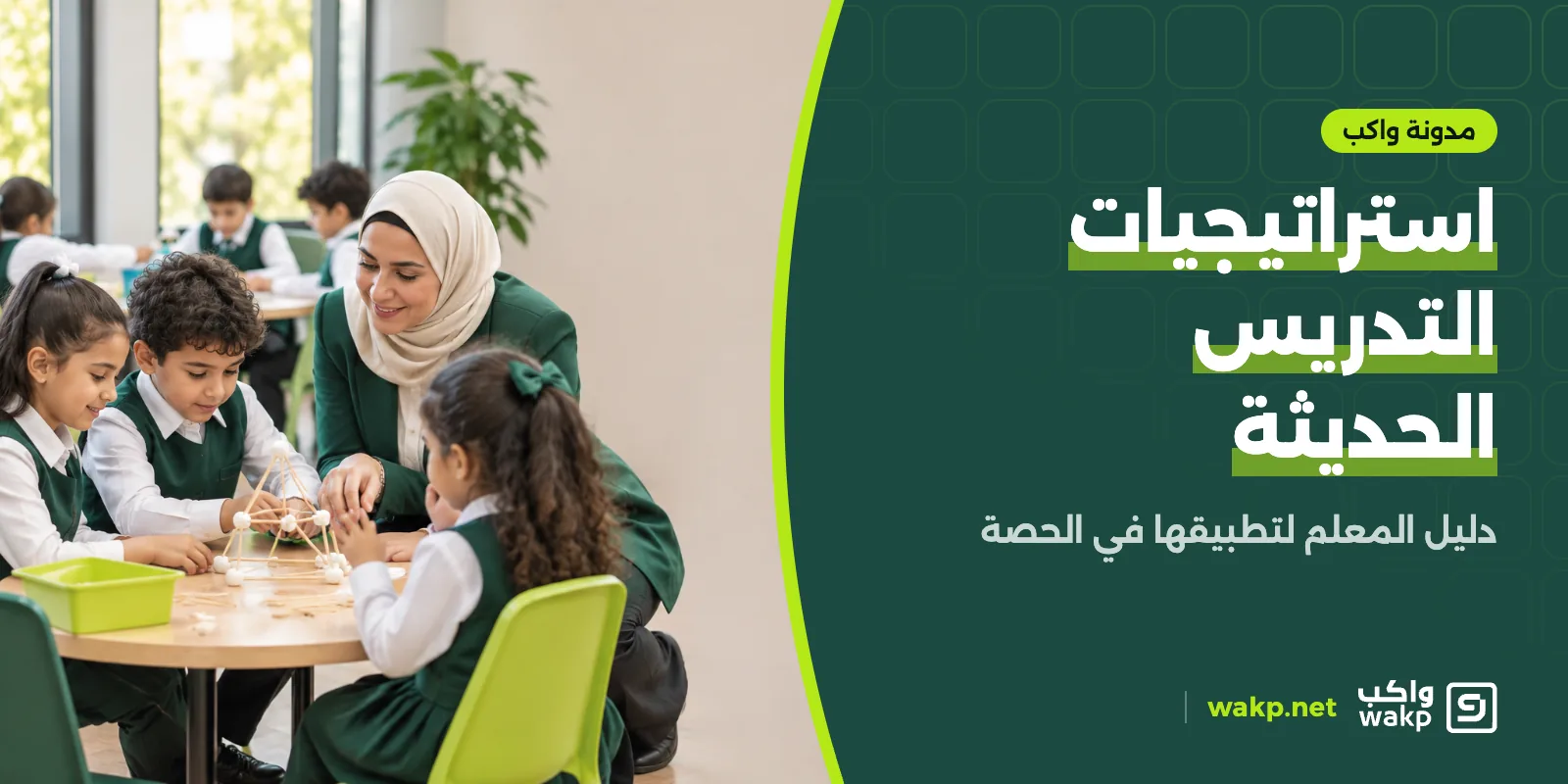
Modern teaching strategies are methods that make the student an active partner in the lesson rather than a passive listener, such as cooperative learning, the flipped classroom, project-based learning and formative assessment. Choose a strategy from the lesson goal, not from how fashionable it is, apply it in small steps and review its effect in the next lesson. Digital tools reduce repetitive work; they do not replace the teacher's role.
Modern teaching strategies are not a fashion list to memorise; they are tools a teacher picks from to suit a lesson. This guide is for the teacher inside the classroom: what do I do in tomorrow's lesson? We cover the main strategies, when each fits, how to run them in small steps and the common mistakes to avoid. If you want the wider picture of improving results across a whole school, read modern education strategies to improve learning outcomes.
What are modern teaching strategies?
Modern teaching strategies are methods that make students participants in building their own understanding instead of just listening. What they share: less time with the teacher talking alone, more time for students to think, apply, explain, err and correct. This does not mean abandoning direct explanation, which often suits a new concept; it means it should not be the only method.
What are the most important modern teaching strategies?
The table summarises the main strategies from the point of view of running them in class.
| Strategy | When it fits | How to start | Common mistake |
|---|---|---|---|
| Cooperative learning | Tasks needing discussion or a joint solution | Groups of three or four with set roles | Leaving groups without roles so one student does everything |
| Flipped classroom | Concepts that can be introduced in advance by short video or reading | One pilot lesson, class time for practice | Long pre-class content students do not watch |
| Project-based learning | Goals needing real production and application | A short project with announced criteria | A project with no criteria, hard to assess |
| Inquiry | Building curiosity, research and explanation | An open question, then defined sources | A question that is too broad |
| Game-based learning | Revision, motivation and early grades | A short game tied to the lesson goal | A fun game unrelated to the goal |
| Formative assessment | Almost every lesson | Short, frequent questions and instant feedback | Giving a mark without explaining the mistake |
| Differentiated instruction | Mixed-level classes | Tasks at different levels for the same goal | Fixing a student at one level permanently |
How do you apply cooperative learning?
Cooperative learning works when roles are assigned and every student is accountable for a part. Divide the class into small groups, set each member's role (reader, recorder, speaker, timekeeper) and make the final product shared, followed by a short individual question. Circulate among groups to hear their understanding rather than standing at the board.
How does the flipped classroom work in practice?
The flipped classroom reverses the order of work: initial explanation before class, application inside class. Keep pre-class content short and specific, with two questions to confirm it was watched, and open the lesson by answering students' questions. An online platform makes it easy to publish the video or file and see who finished, but you can start with a short reading from the textbook.
How do you use formative assessment in the lesson?
Formative assessment means gathering continuous evidence of student understanding during learning, not only at the end. Examples: exit tickets with one question, quick answers on mini whiteboards, and teacher observation during problem solving. Related is teaching students to monitor their own learning; the Education Endowment Foundation (EEF), describing metacognition and self-regulation approaches, points to explicit teaching of such strategies and teachers modelling their own thinking aloud as components of success. For more on assessment tools, read the student assessment system.
How do you choose the right strategy for your lesson?
Choose by asking: what do I want the student to do? If the goal is recalling facts, short questions and revision fit best; for applying a skill, cooperative learning; for production and research, projects and inquiry. Consider lesson length, student age and class size. It also helps to read the qualities of a successful teacher to link strategy to communication and classroom management.
How do you design a lesson that combines several strategies?
The best lessons combine two or three methods in a considered order rather than a random mix. Take a science lesson on the electric circuit as an illustration:
- Open with a formative question about the previous lesson that students answer on a small slip, so you know who needs revision.
- A short direct explanation of the new concept with one clear example.
- A cooperative activity in which each group builds a simple circuit with assigned roles.
- Feedback as you circulate: ask questions rather than correcting at once, so students reach the mistake themselves.
- An exit ticket with two questions on which you plan the start of the next lesson.
This is an example of the shape, not a rigid recipe; adapt it to your subject, your students' level and the time available.
How do you manage the class during activities?
Active activities need clearer management, not less. Agree with students on a signal for silence and for ending the activity, display the time for the task and decide where materials are before starting. If noise rises, it does not always mean the strategy failed; it may be useful discussion. Distinguish task noise from disorder and intervene only in the latter. Do not neglect the shy student: give every member a role that does not require speaking in front of the whole class.
What are the common mistakes when applying a new strategy?
Frequent mistakes that can be avoided:
- Changing everything at once: try one method in one lesson first.
- Careless instructions: students do not know what is required and time is lost. Write the steps on the board.
- No assessment: running the activity with no evidence of what students learned.
- Dropping direct explanation altogether: some concepts need organised explanation before application.
- Judging from the first attempt: a strategy may stumble the first time because students are not used to the method. Repeat and adjust before deciding.
How do modern media help teaching?
Modern educational media support the strategy and do not replace it: a short video for the flipped classroom, a quick-quiz tool for formative assessment and a digital discussion space for cooperative learning. UNESCO's 2023 Global Education Monitoring Report ties technology's contribution to teacher preparation, so start with one tool you master. See the types in modern educational media.
How wakp helps
wakp is a school management system whose online learning (LMS) module lifts repetitive administrative work from teachers so they can focus on teaching:
- Content building: units and lessons (video, file or text) with files, assignments and objective and essay quizzes, suitable for the flipped classroom.
- Content distribution: a teacher builds content once and distributes it to several classes, with review before publishing.
- Live sessions and assignments, with late submission according to school settings.
- Discussions: students ask questions on lessons and the teacher receives an automatic notification.
- Progress tracking: each student's progress per course, who has been inactive for a while and submissions awaiting marking.
- Badges and certificates with clear rules to motivate students.
- Year-work results and submissions: follow what has been marked and what is waiting, within the school's approved assessment rules.
To learn about the module, see LMS; for platforms built for teachers, see a learning platform for the teacher.
The e-learning platform for schools page shows how the module connects to classes and official subjects, and student reports help you review a strategy's effect after you apply it.
How do you fit strategies into limited curriculum time?
The most common teacher complaint is that the curriculum is long and time is short, and activities eat up the lesson. The answer is not to run an activity in every lesson but on the concepts students usually struggle with or that need application. Introduce easy concepts through brief explanation or pre-reading, and save activity time for the hard ones. Split the activity into short stages with an announced time for each, using a timer students can see. If the plan runs late, shorten the activity but do not drop the closing check, because it tells you what the next lesson needs.
Conclusion
Start with one strategy in one lesson, set a clear goal, check the result at the end of the lesson, then adjust. Teaching improves by repeating small experiments, not by changing everything at once.
Frequently asked questions
What are modern teaching strategies?
Methods that involve students in building knowledge instead of relying on lecturing, such as cooperative learning, project-based learning, the flipped classroom, inquiry, game-based learning and formative assessment.
What is the best teaching strategy?
No strategy is best in every situation. The best is the one that fits the lesson goal, the students' age and the lesson time; teachers often combine more than one in a single lesson.
How do I apply the flipped classroom without complexity?
Ask students to watch a short explanation or read a brief text before class, then use class time for practice and questions. Start with a single lesson to see how students respond.
How do I know a strategy worked?
Collect simple evidence in the same lesson: a few short questions at the end, observation of participation and a review of common mistakes, then adjust for the next lesson.
Do I need an online platform to use these strategies?
Not necessarily; most work with paper and discussion. A platform helps with distributing content, assignments and short quizzes, and with seeing who has not engaged.
How to apply a new teaching strategy in your lesson
- Define the lesson goal Write one sentence: what will students be able to do by the end of the lesson?
- Choose one strategy that fits the goal Do not combine several new methods the first time; pick one and decide how much of the lesson it will take.
- Prepare materials and instructions Write out the activity steps, group roles and timing for each step.
- Run it and observe Circulate among students and note common mistakes and where they struggle.
- End with a short check Ask two or three questions at the end of the lesson to see what actually landed.
- Adjust for the next lesson Change timing, instructions or group composition based on what you saw.
Sources
Update log
- — Full rewrite and content refresh
- — Improved internal links