
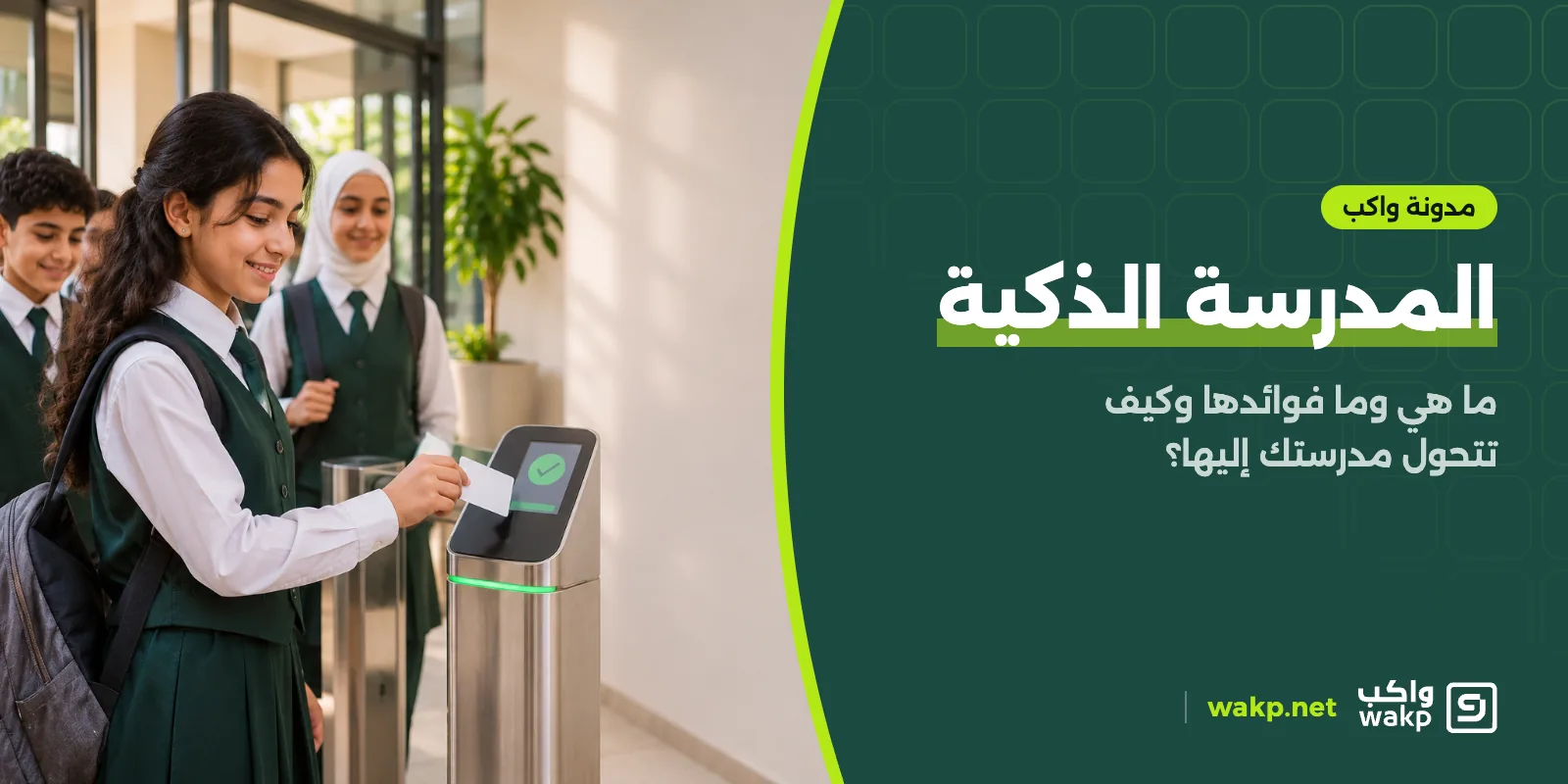
A smart school uses technology across teaching, administration and family communication to improve learning outcomes and operational efficiency, while keeping the teacher at the centre. It is not a shopping list of devices but a system: a learning platform, a management system, data that supports decisions and trained teachers. Start small, tied to real problems, then expand.
A smart school is not a school full of screens. It is a school that connects teaching, administration and communication in one digital system serving teachers, students, parents and management. This guide explains what a smart school means, its goals and technologies, how it differs from a traditional school, and how to begin the shift realistically.
What is a smart school?
A smart school is a school that uses technology in an organised way across teaching, assessment, administration and communication, to improve learning outcomes and cut repeated administrative effort. The teacher remains at the centre and technology supports them.
International bodies agree on this direction. The World Bank says technology should support teachers rather than replace them, and that education is fundamentally about human connections. UNESCO notes that technology needs three conditions to deliver: access, governance and teacher preparation.
Goals of a smart school
- Better learning: varied explanations, personalised follow-up and early detection of struggling students.
- Administrative efficiency: enter data once and reuse it for attendance, reports, results and fees.
- A stronger partnership with families: parents reach attendance, results and notifications on time.
- Data-supported decisions: dashboards that show what needs intervention.
- Preparing students for the future: digital skills, collaboration and self-directed learning.
- Transparency and accountability: documented records for every sensitive action.
Smart school technologies
| Layer | What it includes | Purpose |
|---|---|---|
| School management system | Students, admissions, attendance, timetable, exams control, finance | Unify administrative work |
| E-learning platform | Content, assignments, quizzes, live sessions | Flexible learning in and out of school |
| User portals | Teacher, student and parent portals | Each party reaches what concerns them |
| Communication and notifications | Internal messages and alerts | Documented, fast communication |
| Analytics and follow-up | Dashboards and progress reports | Data-informed decisions |
| Infrastructure | Connectivity, devices, information security | The operating prerequisite |
For classroom tools specifically, see technology in education, and for the learning platform itself read our guide to the learning management system.
Smart school versus traditional school
| Aspect | Traditional school | Smart school |
|---|---|---|
| Records | Paper or separate files | One connected system |
| Attendance and results | Late manual compilation | Real-time recording and reports |
| Family communication | Scattered meetings and calls | Documented notifications, messages and a parent portal |
| Homework and assessment | Paper-based | Online with feedback |
| Management decisions | Experience and judgement | Data alongside experience |
| Teacher's role | Teaching and paperwork | Teaching and guiding, with routine tasks automated |
The difference is not the devices but how systems connect and how information flows.
Benefits of a smart school
For students
More flexible learning, interactive activities, the ability to revisit lessons, and badges and certificates that encourage persistence.
For teachers
Automated attendance, marking of objective quizzes and grade entry, leaving more time to teach. See the qualities of a successful teacher for the skills involved.
For parents
Timely follow-up on attendance, results and fees, with organised notifications instead of scattered calls.
For management
A unified view, fewer errors from re-entering data, and clearer follow-up on collection and operations.
How to turn your school into a smart school
- Assess where you are: where is time lost, and which paper processes repeat?
- Start with the administrative foundation: one system for student data, attendance and results.
- Add parent and teacher portals to cut calls and enquiries; what students and teachers see after sign-in is described in student and teacher portals.
- Roll out e-learning gradually: one subject or grade before everyone.
- Train the team on real usage scenarios.
- Set success measures such as time to publish results and speed of replying to parents, and review them each term.
For wider ideas on improvement, see school improvement ideas. If your institution is a nursery, read our nursery management software guide.
A day in a smart school: a worked example
To make the idea concrete, picture an ordinary day in a school that has adopted an integrated digital system:
- Morning: the teacher records attendance from her portal in minutes, an absence reaches the parent as a notification, and the status appears on the management dashboard.
- During class: the teacher explains the lesson and shows a short video, then launches a five-question quiz whose result appears instantly so she knows who needs to repeat.
- After class: homework is published on the platform, students submit it online and objective questions are marked automatically.
- Evening: a parent reviews homework, attendance and notes, and receives school notifications without a visit or a call.
- Month end: monthly assessment marks are entered and sent for review, and reports are produced without retyping.
The example does not depend on advanced devices but on connected data: what is recorded once appears wherever it is needed.
Smart schools in Egypt and Saudi Arabia
In both countries, the ministry of education is moving toward electronic services and platforms. The official website of Saudi Arabia's Ministry of Education lists e-services such as student registration, school transfers and certificate viewing, and the website of Egypt's Ministry of Education and Technical Education links to services and platforms for students, parents and teachers, such as exam registration, results and a digital library. A private school operating in either country therefore benefits from a system that makes it easier to meet official requirements and that supports local needs for language, currency, calendar (including Hijri Umm al-Qura display for Saudi schools) and payment methods. Check the regulations and circulars in force in your country before launching any digital initiative.
Common mistakes when becoming a smart school
- Starting with devices: buying hardware before defining the problem and the usage plan.
- Separate systems: many programs that do not exchange data recreate the paper problem in digital form.
- Ignoring teachers: imposing a tool without training or involvement leads to rejection.
- Overlooking parents: they need to know what they will receive and how to use the portal.
- Weak security: student data is sensitive and needs defined permissions and an audit trail.
- Scaling too fast: a limited pilot followed by measured expansion works better.
How wakp helps
wakp is an integrated school management system and e-learning platform for schools in Egypt and Saudi Arabia. It provides these real features:
- Student affairs, admissions and registration, attendance and the school timetable.
- Exams control, assessments and results, year-end decisions and promotion.
- Student finance, accounting, school transport, inventory and HR.
- Online learning: courses, lessons, assignments, quizzes, live sessions, badges and certificates.
- Teacher, student and parent portals and an installable web app (PWA) with notifications.
- Internal messaging and a dashboard that shows what needs action.
- Quality and accreditation to document evidence and improvement plans.
Learn more about the wakp school management system.
Its modules include the school timetable software, which checks class clashes, and the school clinic management software for following students' health records.
Frequently asked questions
What is a smart school?
A school that integrates technology into teaching, assessment, administration and family communication to improve learning and efficiency, without removing the teacher's role.
How is a smart school different from a traditional one?
The difference is in how work and information flow: records, communication and assessment are digital and connected, whereas a traditional school relies on paper and separate processes. A traditional school can transition gradually.
Is a smart school just one with modern devices?
No. Devices are a small part. What matters is an educational plan, teacher training, connected systems and data protection rules.
How much does it cost to become a smart school?
It varies with needs and size, so no general figure is honest. Start with a specific problem and one tool, and measure the impact before expanding.
Do small schools qualify?
Yes, the idea scales. A small school may begin with a management system and a parent portal, then add e-learning.
What is the teacher's role in a smart school?
The teacher stays at the centre. Technology reduces routine work and provides clearer data; UNESCO and the World Bank both stress teacher training as essential to success.
Sources
Update log
- — Full rewrite and content refresh
- — Improved internal links; link to the student and teacher portals page